Spacecraft types
Crewed spacecraftedit
As of 2016, only three nations have flown crewed spacecraft: USSR/Russia, USA, and China. The first crewed spacecraft was Vostok 1, which carried Soviet cosmonaut Yuri Gagarin into space in 1961, and completed a full Earth orbit. There were five other crewed missions which used a Vostok spacecraft. The second crewed spacecraft was named Freedom 7, and it performed a sub-orbital spaceflight in 1961 carrying American astronaut Alan Shepard to an altitude of just over 187 kilometers (116 mi). There were five other crewed missions using Mercury spacecraft.
Other Soviet crewed spacecraft include the Voskhod, Soyuz, flown uncrewed as Zond/L1, L3, TKS, and the Salyut and Mir crewed space stations. Other American crewed spacecraft include the Gemini spacecraft, the Apollo spacecraft including the Apollo Lunar Module, the Skylab space station, the Space Shuttle with undetached European Spacelab and private US Spacehab space stations-modules, and the SpaceX Dragon 2. China developed, but did not fly Shuguang, and is currently using Shenzhou (its first crewed mission was in 2003).
Except for the Space Shuttle, all of the recoverable crewed orbital spacecraft were space capsules.
- Crewed space capsules

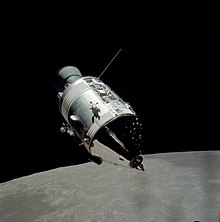
American Mercury, Gemini, and Apollo spacecraft

Soviet Voskhod (variant of Vostok)

1967 Soviet/Russian Soyuz spacecraft

Chinese Shenzhou

Line drawing of Vostok capsule


The International Space Station, crewed since November 2000, is a joint venture between Russia, the United States, Canada and several other countries.
Spaceplanesedit
Some reusable vehicles have been designed only for crewed spaceflight, and these are often called spaceplanes. The first example of such was the North American X-15 spaceplane, which conducted two crewed flights which reached an altitude of over 100 km in the 1960s. The first reusable spacecraft, the X-15, was air-launched on a suborbital trajectory on July 19, 1963.
The first partially reusable orbital spacecraft, a winged non-capsule, the Space Shuttle, was launched by the USA on the 20th anniversary of Yuri Gagarin's flight, on April 12, 1981. During the Shuttle era, six orbiters were built, all of which have flown in the atmosphere and five of which have flown in space. Enterprise was used only for approach and landing tests, launching from the back of a Boeing 747 SCA and gliding to deadstick landings at Edwards AFB, California. The first Space Shuttle to fly into space was Columbia, followed by Challenger, Discovery, Atlantis, and Endeavour. Endeavour was built to replace Challenger when it was lost in January 1986. Columbia broke up during reentry in February 2003.
The first automatic partially reusable spacecraft was the Buran-class shuttle, launched by the USSR on November 15, 1988, although it made only one flight and this was uncrewed. This spaceplane was designed for a crew and strongly resembled the U.S. Space Shuttle, although its drop-off boosters used liquid propellants and its main engines were located at the base of what would be the external tank in the American Shuttle. Lack of funding, complicated by the dissolution of the USSR, prevented any further flights of Buran. The Space Shuttle was subsequently modified to allow for autonomous re-entry in case of necessity.
Per the Vision for Space Exploration, the Space Shuttle was retired in 2011 mainly due to its old age and high cost of program reaching over a billion dollars per flight. The Shuttle's human transport role is to be replaced by SpaceX's SpaceX Dragon 2 and Boeing's CST-100 Starliner. Dragon 2's first crewed flight occurred on May 30, 2020. The Shuttle's heavy cargo transport role is to be replaced by expendable rockets such as the Space Launch System and ULA's Vulcan rocket, as well as the commercial launch vehicles.
Scaled Composites' SpaceShipOne was a reusable suborbital spaceplane that carried pilots Mike Melvill and Brian Binnie on consecutive flights in 2004 to win the Ansari X Prize. The Spaceship Company will build its successor SpaceShipTwo. A fleet of SpaceShipTwos operated by Virgin Galactic was planned to begin reusable private spaceflight carrying paying passengers in 2014, but was delayed after the crash of VSS Enterprise.
Uncrewed spacecraftedit
 | This section needs expansion. You can help by adding to it. (March 2011) |
Semi-crewed – crewed as space stations or part of space stationsedit
- Progress – uncrewed USSR/Russia cargo spacecraft
- TKS – uncrewed USSR/Russia cargo spacecraft and space station module
- Automated Transfer Vehicle (ATV) – uncrewed European cargo spacecraft
- H-II Transfer Vehicle (HTV) – uncrewed Japanese cargo spacecraft
- SpaceX Dragon – uncrewed private spacecraft
- Tianzhou 1 – China's uncrewed spacecraft
- Cygnus – uncrewed commercial spacecraft
Earth-orbit satellitesedit
- Explorer 1 – first US satellite
- Project SCORE – first communications satellite
- Solar and Heliospheric Observatory (SOHO) - orbits the Sun near L1
- Sputnik 1 – world's first artificial satellite
- Sputnik 2 – first animal in orbit (Laika)
- Korabl-Sputnik 2 – first capsule recovered from orbit (Vostok precursor) – animals survived
- Syncom – first geosynchronous communications satellite
- Hubble Space Telescope – largest orbital observatory
- X-37 – spaceplane
Lunar probesedit
- Clementine – US Navy mission, orbited Moon, detected hydrogen at the poles
- Kaguya JPN – lunar orbiter
- Luna 1 – first lunar flyby
- Luna 2 – first lunar impact
- Luna 3 – first images of lunar far side
- Luna 9 – first soft landing on the Moon
- Luna 10 – first lunar orbiter
- Luna 16 – first uncrewed lunar sample retrieval
- Lunar Orbiter – very successful series of lunar mapping spacecraft
- Lunar Prospector – confirmed detection of hydrogen at the lunar poles
- Lunar Reconnaissance Orbiter – Identifies safe landing sites and locates Moon resources
- Lunokhod - Soviet lunar rovers
- SMART-1 ESA – Lunar Impact
- Surveyor – USA's first soft lander
- Chang'e 1 – China's first lunar mission
- Chang'e 2 – China's second lunar mission
- Chang'e 3 – China's first soft landing on the Moon
- Chang'e 4 – first soft landing on far side of the Moon
- Chandrayaan 1 – first Indian Lunar mission
- Chandrayaan 2 – second Indian Lunar mission
Planetary probesedit
- Akatsuki JPN – a Venus orbiter
- Cassini–Huygens – first Saturn orbiter and Titan lander
- Curiosity – Rover sent to Mars by NASA in 2012
- Galileo – first Jupiter orbiter and descent probe
- IKAROS JPN – first solar-sail spacecraft
- Mariner 4 – first Mars flyby, first close and high resolution images of Mars
- Mariner 9 – first Mars orbiter
- Mariner 10 – first Mercury flyby, first close up images
- Mars Exploration Rovers (Spirit and Opportunity)– Mars rovers
- Mars Express – Mars orbiter
- Mars Global Surveyor – Mars orbiter
- Mars Orbiter Mission (Mangalyaan) - India's first Interplanetary probe
- Mars Reconnaissance Orbiter – an advanced climate, imaging, sub-surface radar, and telecommunications Mars orbiter
- MESSENGER – first Mercury orbiter (arrival 2011)
- Mars Pathfinder – Mars lander, carrying the Sojourner rover
- New Horizons – first Pluto flyby (arrival 2015)
- Pioneer 10 – first Jupiter flyby, first close up images
- Pioneer 11 – second Jupiter flyby and first Saturn flyby (first close up images of Saturn)
- Pioneer Venus – first Venus orbiter and landers
- Vega 1 – Balloon release into Venus atmosphere and lander, mothership continued on to fly by Halley's Comet. Joint mission with Vega 2.
- Venera 4 – first soft landing on another planet (Venus)
- Viking 1 – first soft landing on Mars
- Voyager 1 - flybys of Jupiter, Saturn, and Saturn's moon Titan
- Voyager 2 – Jupiter flyby, Saturn flyby, and first flybys/images of Neptune and Uranus
Other – deep spaceedit
- Cluster
- Deep Space 1
- Deep Impact
- Genesis
- Hayabusa
- Near Earth Asteroid Rendezvous
- Rosetta
- Stardust
- STEREO – Heliospheric and solar sensing; first images of the entire Sun
- WMAP
Fastest spacecraftedit
- Parker Solar Probe (estimated 343,000 km/h or 213,000 mph at first sun close pass, will reach 700,000 km/h or 430,000 mph at final perihelion)
- Helios I and II Solar Probes (252,792 km/h or 157,078 mph)
Furthest spacecraft from the Sunedit
- Voyager 1 at 148.09 AU as of January 2020, traveling outward at about 3.58 AU/a (61,100 km/h; 38,000 mph)
- Pioneer 10 at 122.48 AU as of December 2018, traveling outward at about 2.52 AU/a (43,000 km/h; 26,700 mph)
- Voyager 2 at 122.82 AU as of January 2020, traveling outward at about 3.24 AU/a (55,300 km/h; 34,400 mph)
- Pioneer 11 at 101.17 AU as of December 2018, traveling outward at about 2.37 AU/a (40,400 km/h; 25,100 mph)
Unfunded and canceled programsedit
Crewed spacecraftedit
- Chinese Shuguang capsule
- Soviet Zond/L1 – lunar flyby capsule
- Soviet L3 – capsule and lunar lander
- Soviet LK – lunar lander
- Soviet TKS – space station resupply capsule
- Soviet Buran-class shuttle – spaceplane
- Soviet Soyuz Kontakt capsule
- Soviet Almaz space station
- US Manned Orbiting Laboratory space station
- US Altair lunar lander
Multi-stage spaceplanesedit
- US X-20 spaceplane
- Soviet Spiral shuttle
- Soviet/Russian Buran-class shuttle
- ESA Hermes shuttle
- Kliper Russian semi-shuttle/semi-capsule
- Japanese HOPE-X shuttle
- Chinese Shuguang Project 921-3 shuttle
SSTO spacecraftedit
- RR/British Aerospace HOTOL
- ESA Hopper Orbiter
- US DC-X (Delta Clipper)
- US Roton Rotored-Hybrid
- US VentureStar


Comments
Post a Comment